Tag Archive | "Diversity"

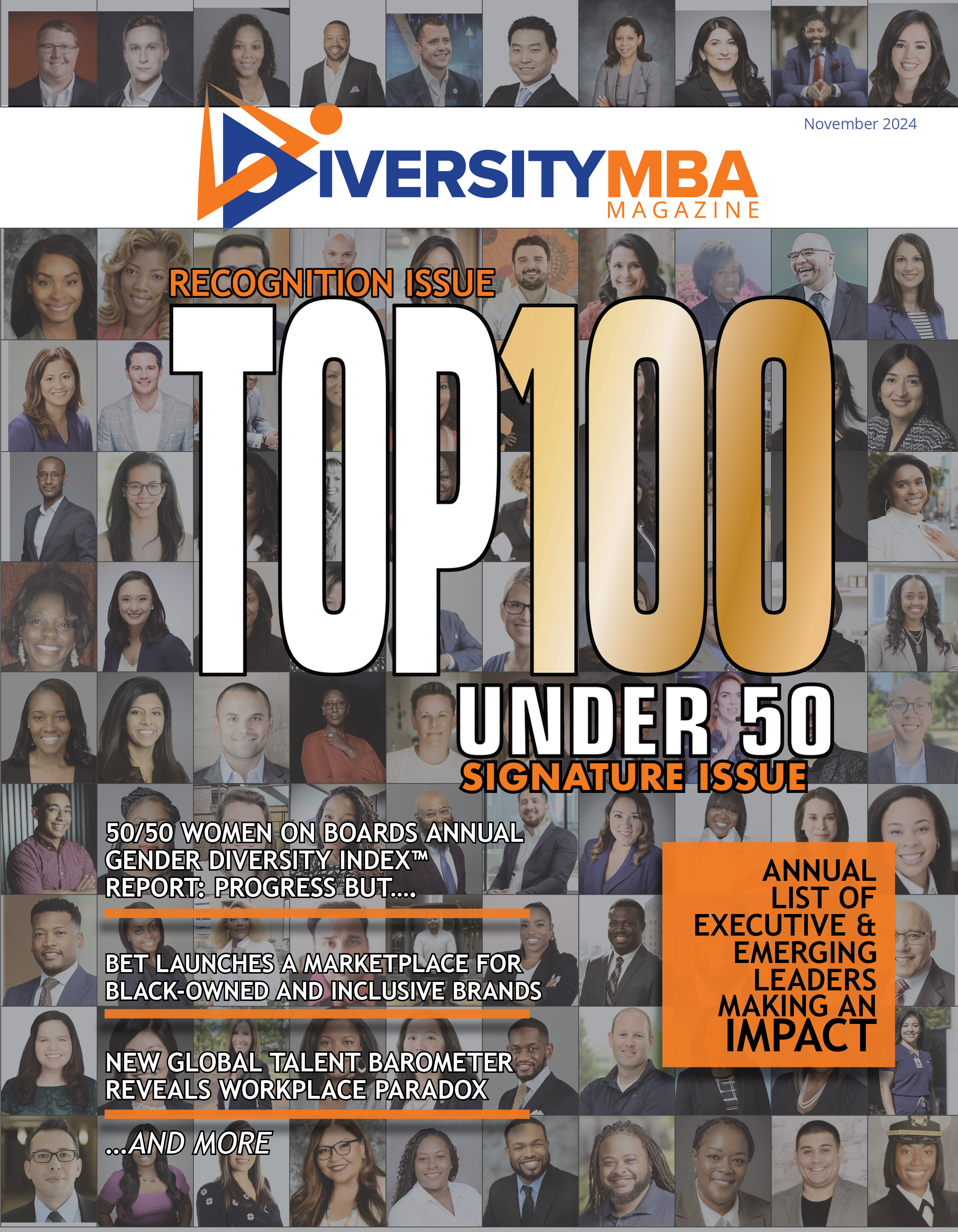
Read The Leadership Issue Of Diversity MBA Magazine Online


Find out what works for corporate leaders. And learn how to put it to work for you.

Read the Leadership Issue of Diversity MBA Magazine right now! For a limited time, you can read it online.

We offer each issue online as a NxtBook. The NxtBook platform gives you the reading experience of the magazine with the convenience of an online publication. You can easily email articles to colleagues or share articles on social sites like Facebook or Linkedin.

Leadership Issue

Leadership Issue

Some Highlights from this issue:

Read the Leadership Issue Now! Click the Magazine —->

  • Delicious
  • Digg
  • Facebook
  • LinkedIn
  • MySpace
  • StumbleUpon
  • Technorati Favorites
  • Twitter
  • Reddit
  • Share/Bookmark

Posted in MBAComments Off

The Role of Diversity in IT Innovation


The lack of diversity in the IT workforce isn’t just a matter of filling jobs by numbers; we are blunting a key national differentiator if we don’t fully involve our diverse population in the invention of new technology. There is a strong return on investment to companies that diversify their IT workforce, including better decision-making, higher return to shareholders, and technological design more applicable to a wide range of customer needs. And yet IT professionals are still culled from a very narrow segment of our population.

Why should we care about information technology? Information technology is the language and toolbox of our modern lives. We use it to communicate and to innovate, in our work and in our play. It is the means for our individual well-being and our collective progress. Simply put, we live in a global information-age economy, one in which increasing knowledge drives our society.

According to the OECD Science, Technology, and Industry (STI) Scoreboard, IT continues to be a key contributor to economic growth, accounting for approximately one-quarter of all productivity gains in the U.S. economy.

In his opening remarks at the Town Hall, Microsoft Research Senior Vice President and NCWIT Executive Advisory Council member Rick Rashid called innovation the key driver of the U.S. economy, and addressed the need for more students to pursue careers in the innovative world of information technology. The Town Hall also featured remarks by Motorola Executive Vice President and Chief Technology Officer Padmasree Warrior, who noted that “IT is a vital component in everything today, from national security and homeland security to commerce and other scientific disciplines.”  Town Hall participants included U.S. Rep. Mark Udall (D-Colo.); National Academy of Engineering president Dr. William A. Wulf; National Science Foundation (NSF) deputy director and chief operating officer Dr. Kathie L. Olsen; NSF Broadening Participation in Computing program director Jan Cuny; Computing Research Association director of government affairs Peter Harsha, and other representatives from the executive branch and Congress. At the NCWIT reception following the Town Hall, U.S. Sen. Barack Obama (D-Ill.) cited the need to reverse “long historic discrimination in the area of gender” saying that locking women out of IT is “like having one hand tied behind our competitive backs.”diverse_contributors

He mentioned his own daughters while hailing the importance of opening doors for members of underrepresented groups to participate in whatever field they choose. Ilene H. Lang, president of Catalyst, also spoke at the reception, citing her organization’s recent research on women in leadership positions. Catalyst is an active member of NCWIT’s Workforce Alliance, which leads efforts in corporate institutional reform and helps NCWIT gauge its success in achieving workforce gender parity. Lang said that the number of Fortune 500 company boards with 25 percent or more women has increased almost six-fold—from 11 in 1995 to 64 in 2005. Yet women still hold only a small number of all Fortune 500 board seats. The dialogue at the Town Hall covered extensive ground, with conversations ranging from passionate appeals for reform to specific suggestions and solutions.

Some of the recommendations included:

For educators: Use novel methods of working computing concepts into other core courses at the K-12 level; emphasize computing’s more relevant, social, and creative elements; reach out to guidance counselors with respect to IT careers – explain what “real” IT jobs are like and why they should be recommended; and look to minority-serving institutions as a graduate school pipeline.

For corporations and business owners: Support re-training of retirees as IT teachers and as resources for classroom teachers; commit to better representation of women and minorities in technical leadership positions; create bridge programs for people wanting to re-enter the IT workforce, providing them with training and mentoring.

For government: Pass and implement innovation legislation; and support sustaining infrastructures to ensure that progress continues over the long term.

For not-for-profits: Work together and share resources; commit to practices that have been shown, through evaluative evidence, to work; and use distribution lists and member bases to build awareness and activism.

For the media: Foster a more accurate representation of IT and its practitioners; realize that diversity has a critical role to play in maintaining U.S. leadership in IT innovation; seek out and report stories that support diversity in IT.

Diversity is an opportunity, not an obstacle. Many avenues exist through which to increase the number of women and minorities participating in every aspect of information technology — if we just work together. As a society, we must recognize and mobilize:

Recognize that this is an issue we must address, and mobilize for rapid change. We must form alliances including but not limited to industry representatives, public and private school teachers, university faculty and administrators and others who can be change agents. We need to focus on institutional reform, based on practices that have been proven to be effective by solid research. We need to reform curriculum at K-12, ensuring that computer science is taught in high schools as well as at higher education levels. We need to improve the public image of computing so young people understand that, far from a narrow technical field suited only to white male hackers, computing is socially valuable work that can be a good career choice for a diverse cross-section of America.

In short, we need to broaden the appeal of IT to people who previously may have considered themselves merely its consumers and not its creators. When we do, the face of IT will begin to change and to better reflect the face of the nation.

Lucinda Sanders is the CEO of the National Center for Women & Information Technology.

  • Delicious
  • Digg
  • Facebook
  • LinkedIn
  • MySpace
  • StumbleUpon
  • Technorati Favorites
  • Twitter
  • Reddit
  • Share/Bookmark

Posted in Latest News, TechnologyComments Off

Achieve Diversity Results with a Whole System Approach


About a decade ago, I had an epiphany about whole systems thinking when my project team and I were asked to figure out why an effort to digitize the company’s backup data systems was failing. After reading about the business trends of companies converting tapes to CD-ROM, an executive at my company thought that he could save the company millions by digitizing data onto CD-ROM instead of storing larger tapes at a third-party storage facility. After six months of running on the new CD-ROM-based platform, however, the company’s savings were negligible, nowhere near expectations. When the troubleshooting team compared our process to that of companies that had successfully lowered their back-up storage costs, they quickly discovered the problem. While moving to the CD-ROM approach was a good move, it was only one of the significant changes that other companies had instituted across their whole back-up storage system. We had looked at only one piece in the data-storage chain.

Since then, I have repeatedly observed how companies – in many different situations and in many different environments – fail to understand the entire context of a problem. This is especially the case with many diversity efforts. Diversity consulting leaders such as Linda Stokes, CEO of the Orlando, Fla.-based firm PRISM International, say piecemeal efforts with narrow scopes are very common in the world of corporate diversity — usually resulting in frustration and failure. Read the full story

  • Delicious
  • Digg
  • Facebook
  • LinkedIn
  • MySpace
  • StumbleUpon
  • Technorati Favorites
  • Twitter
  • Reddit
  • Share/Bookmark

Posted in OrganizationsComments Off

What’s Your Leadership DQ? by Patricia Pope


We all know what IQ is, and accept that, generally speaking, those in management and leadership positions have a reasonably high one or they wouldn’t have made it to where they are. In recent years, we’ve also become familiar with the term EI, or Emotional Intelligence, also been referred to as EQ. Through extensive research by Daniel Goleman and others, research has shown that the higher one goes in an organization, the more important EQ becomes. It’s considered to be at least three times as important as IQ and technical skill combined, and according to Goleman, accounts for 85-90% of the success of organizational leaders.

In his book Emotional Intelligence (Bantam, 1997), Goleman created four discreet categories for better understanding the elements of EI:  Self-Awareness, Self-Management, Social Awareness and Relationship Management. Given the reality of changing demographics in the United States and the increasingly global/international nature of business, it’s important to begin thinking of EQ within the context of DQ, as in, “What’s your Diversity Intelligence?”

As the sheer number and complexity of differences increase and most organizations find that they are being asked to do more with less, work relationships have become more critical than ever before. As a result, it’s important to expand our thinking about the four elements of EQ to recognize the importance of diversity relative to each of them. How self-aware are leaders who have given little thought to the stereotypical notions of others that they have learned as a normal part of our socialization process, and internalized to some degree?  How can they “manage” their internalized stereotypes if they aren’t even aware of them or are denying their existence?  Similarly, if they have spent little time understanding the realities of those different from themselves, they are likely to struggle with both social awareness and relationship management.

Consider research conducted by Travis Bradberry and Jean Greaves in their book, The Emotional Intelligence Quick Book (Foreside, 2005). Over the previous decade, they tested more than half a million people and found that a mere 36% were able to accurately identify their emotions as they happen. Even more disturbing were their specific findings about managers. According to their research, middle managers score highest in terms of EQ. However, those at more senior levels had scores that “descend faster than a skier on a black diamond. CEOs, on average, have the lowest emotional intelligence scores.”

As we continue our transition to becoming a knowledge economy, we are becoming increasingly dependent on our human capital. The organizations that will continue to prosper in the future will be those that link their people strategies directly to their business goals and objectives, and who also recognize that people today are different in a number of ways, and those differences must be taken into account.

There seems to be much more recognition of the need to be able to understand and interact effectively with people differences when organizations are doing business with those from other countries. Not surprisingly, this appears to be an area that many U.S. corporations are struggling with. Ernest Gundling, author of Working GlobeSmart (Davies-Black, 2003) began his book by saying, “The single greatest cause of difficulties in global business transactions is not a lack of technical expertise, hard work, or good intentions – it is a lack of people skills for relating successfully with counterparts from other countries and cultures.”  Frankly, this should not come as a big surprise. Diversity has traditionally been treated as a separate silo and not integrated into training programs designed to increase team effectiveness, leadership development and supervisor/management skills. If we aren’t effectively dealing with all of the human differences that exist here in the U.S., chances are we’ll be even more ineffective when working in another country in a culture markedly different from our own. For some managers and executives, the opportunity to work in another country can cause a breakthrough experience in understanding the importance of differences and their desire to increase their social intelligence. For others, an international assignment is a miserable experience and their performance is mediocre at best.

If we look at emotional intelligence (EQ) within the broader context of diversity (DQ) for leaders in the U.S., we would see this:

  • Self-Awareness: Leaders recognize their beliefs about others that can unintentionally cause them to behave in disrespectful or exclusionary ways.

They know where their personal challenges are in terms of dealing with differences (race/ethnicity, gender, age, sexual orientation, religious, socioeconomic/educational, etc.).

  • Social Awareness: Leaders understand the realities and challenges of others different from themselves and the impact that individual and institutional bias has on those who are experiencing it. They understand the subtle dynamics and barriers that inhibit individual performance and teamwork.
  • Self-Management: Leaders accept ownership for managing their biases. They hold themselves accountable. They can articulate the specific skills they need to work on in order increase their effectiveness with those different from them.
  • Relationship Management: Leaders have acquired skills to build relationships of mutual trust and respect across diverse interfaces. They accept the responsibility for creating an inclusive culture, removing subtle barriers that prevent employees from performing to their fullest potential, and hold others accountable for doing the same.

If you believe your DQ represents a development opportunity but are unsure of where to start, ask yourself questions that can provide introspection and consider some of the suggested actions. Does your organization say it values diversity, yet requires a high level of conformity in order to have a successful career?  While there’s a certain amount of socialization that most will experience when joining a new organization, ask yourself, “How much of me have I had to give up in order to be a part of this organization, and is it different for others?

Initiate conversations with employees from diverse backgrounds (individually or in small groups) and invite them to share how they perceive that conformity is rewarded. A great question is to simply ask, “Please tell me what life is like for you in this organization, given who you are.” To get candid responses, it’s necessary to create a safe environment for the discussion. Set the tone by first sharing your desire to learn, and how much you appreciate their willingness to increase your awareness and understanding by being open with you. Acknowledge that this may require them to take a leap of faith and may feel risky to them. How you respond to what you hear will also be extremely important. Pay attention to your emotional reactions as you’re listening. That’s how we increase our self-awareness.

Although the demands of our positions often dictate who we must spend time with, most of us have some discretionary time, and tend to invest it with those we’ve made a conscious effort to develop/mentor. Ask yourself, “How much energy do I put into developing relationships with others, especially people who are different than me?”  You also can begin to observe or ask your peers and direct reports who they’re informally mentoring. Do your observations and the responses you get from others suggest that those from diverse backgrounds are getting the same opportunities for informal development and coaching?

Work-sponsored social functions are perceived by many as an important vehicle for developing relationships and for networking. Ask yourself, “How often do I notice the demographics of the group in these situations?  If those from diverse backgrounds tend not to attend these events, why not?  What could I learn about them or about our environment if I asked these questions?”

When given negative performance feedback about someone from a diverse background, ask, “Do I merely accept the information or ask additional questions to determine to what degree this individual’s performance may be affected by subtle barriers in the environment?”  It’s also important to examine the quality of the relationship between the “poor performer” and his/her immediate manager. If we don’t ask about it, we’re only focusing on the individual and may not see what is really causing the performance problem. A lot of valuable talent tends to be lost because we don’t.

While our cognitive abilities (basic intelligence) are basically determined at birth, the good news is that it’s never too late to learn when it comes to increasing our EQ and DQ. In fact, it’s a life-long journey.

  • Delicious
  • Digg
  • Facebook
  • LinkedIn
  • MySpace
  • StumbleUpon
  • Technorati Favorites
  • Twitter
  • Reddit
  • Share/Bookmark

Posted in Career Development, MBAComments Off

Diversity Challenge for Executives: Learning to Ask the Tough Questions


Increasingly, organizations that have made a serious commitment to diversity and inclusion are taking a hard look at hiring, turnover and promotion patterns, and challenging themselves with the question, “are there subtle biases operating in these decision-making processes?” Read the full story

  • Delicious
  • Digg
  • Facebook
  • LinkedIn
  • MySpace
  • StumbleUpon
  • Technorati Favorites
  • Twitter
  • Reddit
  • Share/Bookmark

Posted in MBA, OrganizationsComments Off